Your cart is currently empty!
You may check out all the available trips and book one that suits you.
Continue Browsing Trips
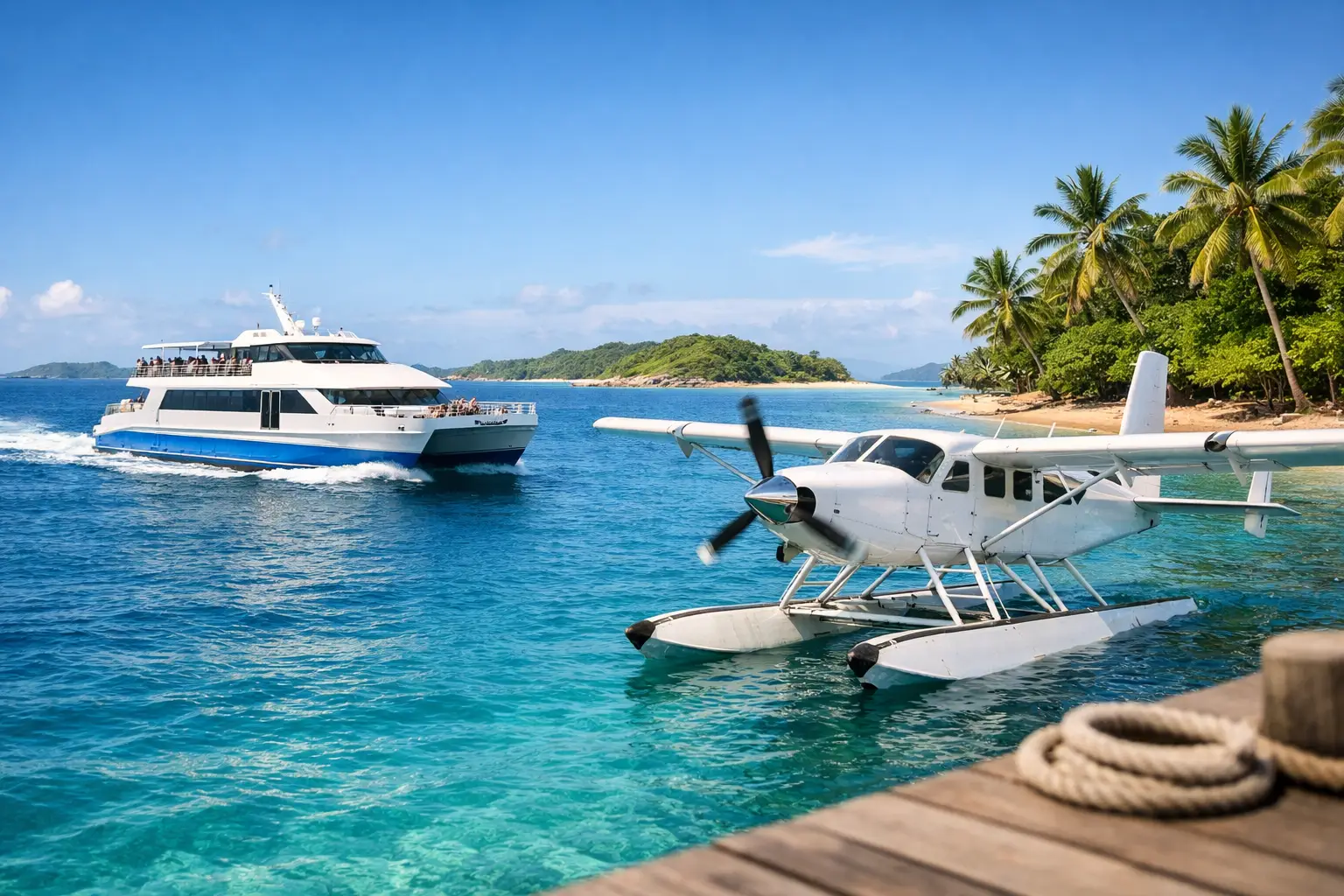
That first island transfer can set the rhythm for your whole holiday. In the Fiji ferry versus seaplane decision, one option gives you a relaxed journey across bright blue water, while the other turns the transfer itself into a spectacular aerial experience. Neither is automatically better. The right choice depends on your island, budget, luggage, travel time and how much you want to fit into every precious day in Fiji.
For travellers arriving through Nadi, ferries and seaplanes are the main ways to reach many Mamanuca and Yasawa Island resorts. Both are reliable, well-used services, but they deliver very different holiday experiences. Here is how to choose with confidence.
A ferry is the practical, social and generally better-value way to travel between Port Denarau and the islands. It is ideal for travellers happy to trade speed for a gentler price and a chance to settle into island time from the moment they board.
A seaplane is a small aircraft that lands directly on the ocean near your resort. It is usually much faster and offers extraordinary views of reefs, sandbars and islands scattered across the Pacific. It is particularly appealing for short stays, special occasions and more remote Yasawa resorts.
The decision often comes down to this: would you rather spend part of the day travelling over the water, or pay more to arrive quickly with a window-seat view you will remember long after the holiday?
Most resort ferry transfers depart from Port Denarau, close to Nadi. Depending on your island, the trip might be a short ride to the Mamanucas or several hours north through the Yasawa Islands. Resorts are generally served by scheduled catamarans, with luggage handled by the crew and transfers arranged to line up with arrival and departure days.
The biggest advantage is value. Ferry travel is typically more affordable than a seaplane, especially for families, groups and travellers carrying standard holiday luggage. It is also a lovely introduction to the islands: take a seat on deck, watch the mainland shrink behind you and enjoy the changing colour of the water as you travel north.
For Mamanuca resorts, ferry times can be very manageable. A journey of roughly 30 minutes to two hours can feel like part of the adventure rather than a long transfer. It also makes sense when your resort is located on a regular ferry route and you are staying long enough that an extra hour or two does not affect your plans.
Ferries normally allow more baggage than small aircraft, which can be helpful for families with prams, travellers bringing dive gear, or anyone with a larger suitcase. Always check the allowance for your specific operator and resort, as conditions can vary.
For distant Yasawa resorts, ferry travel can take a significant part of the day. A route that stops at several islands is scenic but may be tiring after an international flight, particularly with young children or older travellers who prefer less time in transit.
Sea conditions matter too. Modern catamarans are designed for island travel, but wind and swell can make the ride bumpy at times. If you are prone to motion sickness, take your usual remedy before departure, choose a lower and more central seat where possible, and avoid arriving with an empty stomach.
Ferry schedules are fixed. This is usually straightforward, but it means travellers on late-arriving flights may need an overnight stay near Nadi or Denarau before heading to their island. That is not necessarily a bad thing – it can be a welcome chance to rest, enjoy a relaxed dinner and start fresh the next morning.
A seaplane transfer feels like a Fiji holiday highlight rather than simply transport. After taking off near Nadi, you will see coral gardens, tiny uninhabited islands and luminous reef passages from above. On a clear day, the scenery is remarkable, especially when flying towards the outer Yasawas.
Time is the strongest reason to fly. A transfer that may take several hours by ferry can often be completed in well under an hour by seaplane, depending on the resort and flight routing. For a three- or four-night escape, that can mean gaining much more time by the pool, on the beach or out on the water.
Seaplanes are also a brilliant choice for honeymooners, anniversary trips and travellers who want a memorable arrival. There is something genuinely special about touching down on the water and being met near your island resort. For many guests, it is one of the most photographed moments of the trip.
Flying can be especially useful when you are travelling to a far-north Yasawa property. Rather than spending much of your first day on a vessel, you can arrive in time for lunch, an afternoon swim or a sunset drink. For guests with limited mobility, it may also reduce the total travel time, although getting in and out of a small aircraft requires consideration and should be discussed before booking.
The price is the obvious factor. Seaplanes cost more than ferries, sometimes considerably more, so they can take a substantial share of a holiday budget. If the flight means cutting back on experiences you value, such as snorkelling trips, cultural visits or a private island excursion, a ferry may offer better overall value.
Luggage limits are stricter on seaplanes. Soft-sided bags are often easier to manage than large hard cases, and extra baggage may need to travel separately or incur a charge. Check the current allowance before packing, rather than assuming your international flight baggage allowance will apply.
Small-aircraft travel is weather dependent. Fiji’s operators are highly experienced, but flights may be adjusted, delayed or rerouted for safety. This is more likely during periods of unsettled weather. Allow reasonable flexibility in your itinerary, particularly if you need to connect to an international departure on the same day.
If you dislike small aircraft, do not choose a seaplane solely for the photographs. The flights are usually smooth and scenic, but the cabin is compact and engine noise is part of the experience. Ear protection is commonly supplied. Speak with the operator if you have concerns about anxiety, mobility or travelling with an infant.
| Travel factor | Fiji ferry | Fiji seaplane | |—|—|—| | Cost | Usually the more budget-friendly choice | Premium-priced transfer | | Travel time | Best for nearby islands; longer for outer Yasawas | Fastest option for most island resorts | | Views | Ocean-level island scenery and open-air deck time | Exceptional aerial views of reefs and islands | | Luggage | Generally more generous allowances | Strict weight and bag-size limits may apply | | Comfort | Spacious, but can be affected by swell | Short journey, but compact cabin and aircraft noise | | Scheduling | Fixed daily services and multiple island stops | Flight times can be more flexible, subject to demand and weather |
Couples staying in the Mamanucas often find that a ferry is all they need. The islands are relatively close to Port Denarau, and the boat journey adds to the anticipation without taking over the day. Choosing a ferry can leave more room in the budget for a sunset cruise, a guided snorkelling experience or a private dinner.
Families should consider both children’s ages and their usual tolerance for travel. A ferry can be simple and cost-effective, especially with luggage and family gear. Yet a seaplane can be a smart splurge for a young family heading to a distant resort, as it reduces the chance of overtired kids after a long flight. There is no universal answer – your travel day, not just your accommodation, should guide the choice.
For a Yasawa honeymoon or a short luxury stay, a seaplane has real appeal. You are paying for speed, scenery and an unforgettable sense of arrival. Many travellers choose to fly one way and take the ferry the other. This gives you the best aerial view on arrival or departure while keeping costs more balanced.
Travellers on a longer holiday, particularly those island-hopping, may prefer ferries for most transfers. They are well suited to a flexible, exploratory itinerary and allow you to travel through the island chain at a more relaxed pace. Just keep an eye on transfer times when planning activities, as the best Fiji tours are much more enjoyable when you are not rushing to make a boat.
International flight schedules are often the hidden deciding factor. If you land in Nadi after the day’s final ferry has departed, an overnight near Denarau is generally required. A seaplane may have more suitable timing, but it should never be assumed – schedules can change by season, weather and passenger numbers.
For the journey home, avoid a tight connection between an island transfer and an international flight. Ferry and aircraft services operate professionally, but weather, sea conditions and operational changes are part of travel in an island nation. Giving yourself a comfortable buffer turns a potentially stressful final day into one last relaxed morning by the sea.
Best Fiji Activities can help travellers match island transfers with resorts, tours and flight schedules, so the practical details support the holiday rather than complicate it. Ask about current departure times, baggage rules and the best transfer option for your exact island before confirming your itinerary.
The best choice is the one that lets you arrive excited, comfortable and ready to enjoy Fiji. Take the ferry if you want value, space and a slow first taste of island life. Take the seaplane if time is short and you want the reefs of Fiji spread out beneath your feet. Either way, leave a little room in the day for the moment your resort comes into view – that is when the holiday truly begins.